
更新:美国能源信息署柴油价格创纪录;期货价格亦创新高
柴油基准价格创历史新高,用于大多数燃油附加费的基准价格也达到前所未有的高位。该报道《更新:DOE/EIA柴油价格创纪录;期货价格同样创新高》首发于FreightWaves。
With other key diesel prices having broken through several record numbers in the past week, it was time Tuesday for the benchmark number used for most fuel surcharges to do the same.
The Department of Energy/Energy Information Administration average weekly retail diesel price rose 31.8 cents/gallon to $6.285/g, effective Monday but announced Tuesday, the highest price in its history.
Beginning with the first price in July of $4.578/g, the DOE/EIA number is now up $1.707/cts/g.
A few hours after the DOE/EIA number was published, the settlement for the ultra low sulfur diesel contract on the CME commodity exchange came in at $5.262/g, the highest settlement in a history that dates back to 1978.
The DOE/EIA number lags such other indicators as the AAA daily retail diesel price and the SONAR DTS.USA data series on retail prices just because of its frequency. Both those prices had smashed through records since the prior DOE/EIA publication.
The AAA all-time high price had been $5.82/gallon, set back in June 2022 a few months after the Russian invasion of Ukraine. That record was broken last week, with the price then setting a new all-time high Tuesday at $6.2694/g.
The DTS.USA price Tuesday was $6.26, also an all-time high.
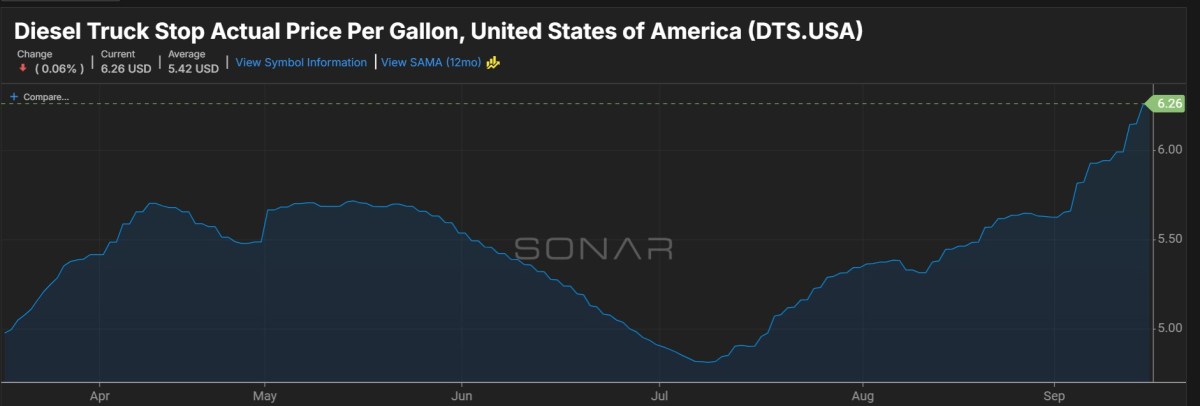
But all of these prices are following the lead of the ultra low sulfur diesel (ULSD) on the CME commodity exchange.
Prior to Thursday, ULSD had only settled above $5/g once, 4/28/2022, a day that was a complete aberration less than two months after the Russian invasion of Ukraine when numerous traders were caught short and needed to cover their position. The settlement that day was $5.1354. By the next day in June 2022, the price was far below the $5/g mark.
The ultra low sulfur #diesel contract on CME/NYMEX started as a heating #oil contract in 1978. It became a diesel contract more than 10 years ago, though its symbol is still HO. It has never settled higher than it did today, at $5.262/g. This is its path since the Iran war began. pic.twitter.com/k23tylZXx5
— John Kingston (@JohnHKingston) September 15, 2026
The earlier higher prices were given another upward kick Monday on news that there has been a shutdown after a power outage at the 264,000 barrel/da Joliet, Illinois refinery of ExxonMobil (NYSE: XOM). While news reports said the power had been restored, it will take an undetermined amount of time to restart the facility.
The Joliet news was just one more development where somebody looking for a reason prices might drop would be hard pressed to find any evidence.
Another disruption to supply occurred late last week, when Houthi forces in Yemen loosely aligned with Iran knocked out the Saudi East-West pipeline. That pipeline, which prior to the war had been lightly used, brings as much as 7 million barrels/day of oil to the port of Yanbu on the Red Sea, away from the uncertain shipping lanes out of the Strait of Hormuz.
Chevron CEO’s warning
Last week, Mike Wirth, the CEO of Chevron, who weeks ago had made a similar prediction even when prices had been softening, was stark in his outlook on the market.
“It’s harder to envision a scenario where prices soften quickly,” Wirth said, according to Reuters. Wirth made the remarks at a University of Texas at Austin energy conference. “I think the risks remain to the upside over the next few months.”
While oil markets have been notable in recent weeks for the strength of diesel and to a lesser degree gasoline, with crude lagging, several analysts recently have commented that such a dynamic likely has been played out.
That does not mean that diesel is falling relative to crude. It just isn’t rising anymore.
Crude not a laggard anymore
Amrita Sen, the director of market intelligence at Energy Aspects, laid out that scenario in a recent CNBC interview for why crude is likely to follow the broader market trends rather than being somewhat on its own.
“Given just how quickly inventories have drawn down since August, and Hormuz flows remain disrupted, and it is very clear China is now back in the market buying, (and) crude isn’t going down anytime soon,” she said.
Crude markets have lagged for several reasons, including the lack of Chinese buying and the fact that the market was trying to absorb a combination of renewed supplies out of the Persian Gulf following some easing of Strait of Hormuz flows, strategic stocks released by various countries and a hefty supply of oil on the water when the Iran war began.
Crude’s relatively ample supplies have been able to help balance the market, Sen said. But with winter coming up, Sen said, “refineries need the crude, so crude isn’t going to go down anytime soon.” Sen said she foresees an “upward spiral” that will lift both crude and products.
In an interview with Bloomberg Television, former Goldman Sachs commodity research head Jeffrey Currie made a similar observation.
China’s renewed buying occurred in part because “you finally got to a point that the spread between products and crude was so large that the Chinese could not resist that profit margin and came back into the market.”
Currie, who has been one of the most vocal market bulls, was asked in the interview last week about demand destruction because of high prices.
“You’ve got demand up here and supply down here,” he said, talking about the imbalance. “What happens? Prices spike, boom, it crushes the two down. Then the prices come off and guess what? Demand tries to come back and then the price spikes back up.”
More articles by John Kingston
Rejigged NLRB likely to target Cemex rule, used by Teamsters to organize
Pink Cheetah, TQL fight it out as transparency rule awaited
At tech/AI confab, C.H. Robinson tackles insurance and liability
The post Update: DOE/EIA diesel at record; so is futures price appeared first on FreightWaves.