
蒙哥马利的另一面:它或许会让人类经纪人更有价值
在一次顶尖的物流并购大会上,作为交易撮合者的人的价值得到了提升。 帖子《蒙哥马利的另一面:它或许会让人类经纪人变得更加有价值》首发于……
Naperville, Illinois–In a day-long conference devoted to the business of logistics mergers and acquisitions, and the markets those companies serve, a guest that wasn’t on the attendee list or the agenda showed up unexpectedly: Montgomery vs. Caribe Transport II.
That recent Supreme Court decision opening the door to greater broker liability could always be seen as having the potential to spur M&A activity in 3PLs, as smaller companies that might be faced with higher insurance premiums and other costs necessary to protect themselves in an uncertain legal atmosphere look to be folded into a bigger parent with greater resources.
But that is not how it came up in discussions at the Logisyn Advisors M&A Club conference here. Logisyn is a leading M&A advisor in logistics.
Instead, its significance was raised in a discussion by Beth Carroll, CEO of the Prosperio Group. She was on a panel focused on developing and keeping talent. .
What she said should be good news to brokers who see the possibility of AI taking their jobs, as already has been evidenced by the company earnings released by C.H. Robinson (NASDAQ: CHRW) that for several years and still ongoing have shown a steady decline in the brokerage’s head count even as its volume and profits have risen.
Carroll, whose book “Taming the Compensation Monster” on broker freight compensation was distributed to all the attendees at the Logisyn conference, described the impact of Montgomery as “another whole layer on top of everything.”
Montgomery vs. Caribe Transport II, in a unanimous Supreme Court decision in May, stripped away a key defense brokers have used to protect themselves from liability and negligence claims for many years.
Carroll said in studying AI, she had developed concern for the future of the down-in-the-trenches broker. “I thought, is there really going to be a future for the traditional carrier sales type role?” she said. “Is that something that’s going to be completely automated?”
But post-Montgomery, Carroll said her conclusion is “I don’t think so.”
Do you want to testify to this?
“You’re not going to stand up in court and say, well, how did this truck get booked that you know ended up killing people?” Carroll said, envisioning testimony in a lawsuit. The answer brokers are not going to want to give, she said, is “well, AI made the choice.”
“No, you’re going to need to have human beings that are behind that decision, and lots of controls and compliance around the rules that are being used to make that decision,” Carroll said.
And it can extend to other areas, she added. For example, “do you want to have that same conversation in front of a jury and tell them that your carrier sales rep is on a 100% commission plan?” Carroll said.
While Carroll did not go into detail on that observation, the inference was clear: a compensation package that is fully dependent on volume does not necessarily incentivize safe behavior. And with Montgomery now a firmly-established legal precedent, that could be a significant problem in a lawsuit.
Volume as a pay basis going to create some issues
But while Carroll said the combination of AI and Montgomery could be viewed as more of a “pro-human” incentive at a 3PL, it can create all sorts of problems for compensation packages.
Carroll said most brokers think in terms of loads per day. “That’s a common metric that is used,” she said.
But with AI at 3PLs raising the prospect of loads per day rising sharply for those who master its capabilities, that could create issues with compensation, Carroll said, calling it “a problem that is coming fast for them.”
“Productivity is going to increase, and on straight commission plans, that means pay is going to increase at the exact same rate, unless something is done to change it,” Carroll said.
What will be needed, she said, is an “adjustment factor,” because a company is going to need to tell its brokers on straight commission that “we’re not going to be able to pay you for your gross margin, because now you’re actually doing 50% more with the same amount of effort.”
Carroll wondered how many brokers have had a discussion with their employees where they needed to say “Look, we’re going to have to cut your commission rate.”
“How many of you have had that conversation?” Carroll said. “It doesn’t go well, does it?”
AI not impacting CEO searches
But that’s in the rank and file. Mike Knox, senior managing partner of recruiting firm GESG who was on the panel with Carroll, said he has yet to have an executive search where AI knowledge and experience has been part of the process.
But Knox followed that up with a comparison of traditional pay packages for 3PL leaders that implicitly acknowledges the importance of technology.
For companies awarding equity, a standard structure might have been a five-year or three-year vesting for that equity, Knox said. But now, he added, “if you’re not performing in 18 months, there’s pressure with what your competitors are doing, all driven by technology.”
Sarah Barnes-Humphrey, the owner of Let’s Talk Supply Chain, who moderated the panel, expressed concern about where the next generation of C-suite executives is going to come from if AI does reduce the number of so many lower-level employees.
“What does that mean for leadership in the future when we don’t really have the critical thinking skills that we develop from having that experience, and how do we have a human in the loop that doesn’t have the knowledge and experience that we get from an entry-level job?” Barnes-Humphrey said.
Has it been a good year for M&A?
There are similarities between the Logisyn conference and the Benesch law firm conference on private equity in logistics held in New York each December. Many of the topics overlap.
At the end of 2025 at the Benesch conference, a banner year for logistics M&A in 2026 was predicted by among others, Ron Lentz, the managing director at Logisyn.
So how’s it going?
Logisyn each month publishes a report on the prior month’s total of logistics deals from around the world. It had not been showing a significant upturn in the number of deals done until recent months.
A shift in methodology led the August numbers to soar. Logisyn and transportation research firm Ti-Insight said they had adopted “an improved tracking system that will provide a more comprehensive logistics M&A transaction database month over month.”
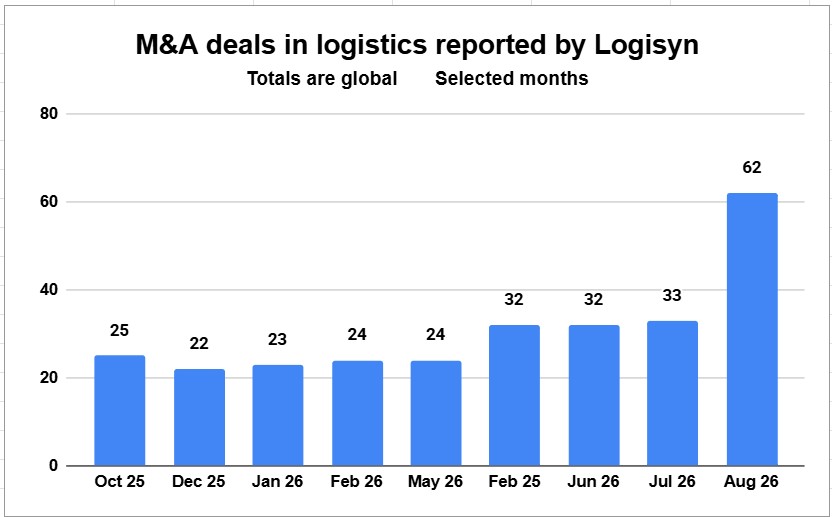
The data from the new methodology showed August deals around the world at more than double what has been reported in recent months, though with a new methodology the comparison is not apples to apples.
But in its report for August, Logisyn said the market was strong. “Rapid investment across data centers, energy, renewables and infrastructure is creating a new growth cycle for project logistics and specialized transportation,” the report said. “These capital-intensive industries require moving increasingly large, heavy, and complex components, driving demand for heavy-haul transportation, specialized lifting equipment, project forwarding, and engineering expertise.”
In other highlights from the Logisyn M&A Club conference:
- A deal was actually announced from the stage. As the first session was wrapping up, Kendra Tanner, president and CEO of AllStates World Cargo, announced the company was being acquired by Eve Partners. And to confirm the deal, J.J. Schickel, a partner at Eve, was sitting next to Tanner when the announcement was made.
- Cameron Roberts, managing partner of Roberts & Kehagiaras LLP, on a panel entitled “Resilience in the face of global geopolitical crises,” offered perspective on dealing with U.S. Customs and Border Protection (CBP). The resources that CBP is bringing to its enforcement efforts is “at an all-time high,” Roberts said. At a recent trade summit, Roberts said, officials from CBP told the audience that its message is “prove to me that you’re a good broker. Prove to me that you’re a good importer.” Roberts added that the “concept of facilitation,” where the CPB would mostly look to ease the path of an importer, has disappeared.”The concept is enforcement and the presumption of people doing things the wrong way,” he said.
Why it’s important: AI appears to be a force for job destruction in 3PLs. But at a leading conference, the value of humans in the new fight over broker liability was touted by a speaker. It was seen as helping a broker’s defense in litigation after a crash or other incident.
More articles by John Kingston
Rejigged NLRB likely to target Cemex rule, used by Teamsters to organize
Pink Cheetah, TQL fight it out as transparency rule awaited
At shippers’ confab, defining a ‘fragile’ trucking market
The post Another aspect of Montgomery: it might make human brokers more valuable appeared first on FreightWaves.