
Damaged Freight Claims: POD, Photos and Claim Filing Steps
Learn how to document damaged freight, complete the POD and BOL, preserve packaging, meet claim deadlines, and avoid common reasons freight claims are denied.
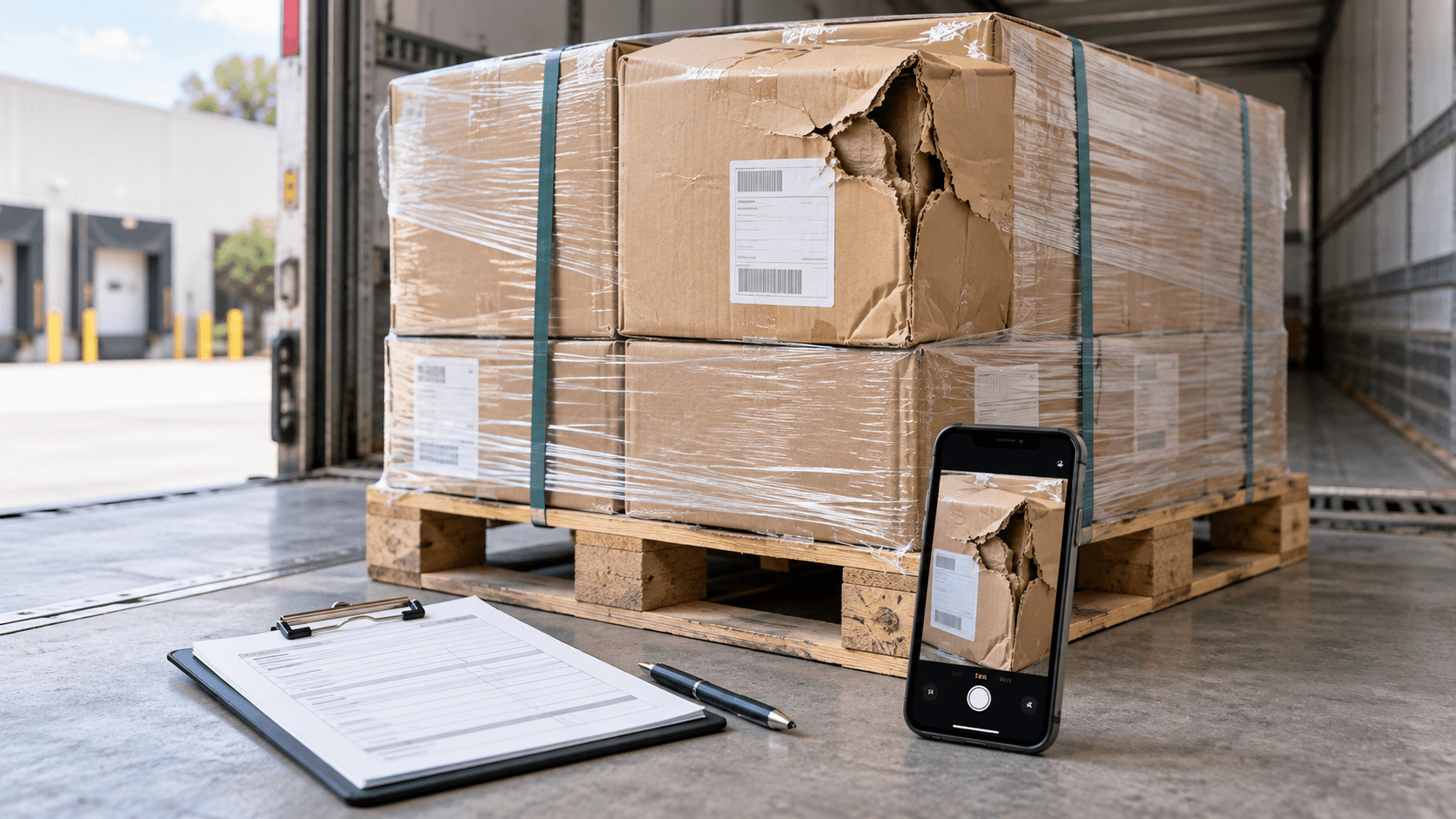
Discovering damaged freight at delivery can be frustrating, but what you do next may determine whether your freight damage claim is accepted or denied.
The most important steps are to inspect the shipment before signing, record visible damage or shortages on the Proof of Delivery (POD), preserve the original packaging, and collect clear photographic evidence. Missing one of these steps can make it difficult—or impossible—to recover the value of the affected goods.
Important: Claim requirements and deadlines vary by carrier and shipping platform. The timelines below reflect UUCargo's claim submission requirements; always confirm the terms that apply to your shipment.
What Is Damaged Freight?
Damaged freight includes goods that are crushed, bent, scratched, wet, punctured, broken, or otherwise affected while being transported. Damage may be obvious when the shipment arrives, or it may be concealed inside packaging that appears intact.
Common warning signs include crushed cartons, torn stretch wrap, broken pallets, leaning freight, water marks, dents, punctures, and missing cartons or components. Both visible and concealed damage should be documented immediately.
Inspect Before Signing the Proof of Delivery
The Proof of Delivery records that the shipment was delivered and received. Before signing it:
- Count every carton, pallet, or individual piece.
- Inspect all visible sides of the shipment.
- Look for crushed corners, holes, tears, water marks, broken wrapping, or shifted freight.
- Compare the delivered quantity with the Bill of Lading and packing list.
- Photograph anything that appears damaged or unusual.
If you find damage, write “DAMAGED” clearly on the POD. If items are missing, write “LOST” or “SHORTAGE” and record the missing quantity. Do not sign the POD as received in good condition before completing the inspection.
Claim Reporting Deadlines
| Delivery record | Reporting requirement |
|---|---|
| POD has no lost, shortage, or damaged notation | Report the issue within 24 hours of delivery. Claims reported after 24 hours are not accepted. |
| POD shows lost, shortage, or damaged | Notify the platform within three business days. |
| Carrier directly confirms the loss or damage | A POD may not be required, but all other supporting documents should still be retained. |
Why the Bill of Lading Matters
A Bill of Lading (BOL) describes the freight being transported and confirms the carrier's receipt of the shipment. For a lost or short shipment, it should clearly show the number of pieces tendered to the carrier.
A lost or shortage claim will not be accepted when the order does not list the piece count, or when individual quantities are listed but the driver did not participate in the count and sign for the quantity. Descriptions on the order, BOL, commercial invoice, and packing list must also be consistent.
Documents Required for a Freight Claim
Prepare the following documents when submitting a damaged freight claim:
- POD with a clear damaged notation
- Signed Bill of Lading
- Commercial invoice and proof of product value
- Customs invoice, when applicable
- Product sales page or listing
- Packing list
- Photographs of the product, packaging, label, and damage
Electrical products, chemicals, hazardous materials, and other regulated goods must be declared correctly when the shipment is booked. Undeclared restricted goods may make the shipment ineligible for a claim.
Required Damaged Freight Photos
Photographs must show more than the damaged area. The claims team needs to understand how the goods were packaged, where the damage occurred, and whether the packaging offered reasonable protection.
- Shipping label: Take a close-up showing the label and tracking information.
- Damaged product: Photograph every affected item from several angles.
- Product inside its original box: Show its original position and all cushioning before removal.
- Internal packaging: Photograph bubble wrap, foam, cardboard dividers, corner protectors, and other materials.
- All six sides: Use one photo for the top and two sides, and a second for the bottom and opposite sides.
- Package dimensions: Record length, width, and height, preferably with a measuring tape visible.
- Pre-shipment condition: Include photos taken before shipping whenever available.
Do Not Install Damaged Products
Do not assemble, install, repair, or continue using a damaged product before the claim has been reviewed. Installing it changes its original condition and can make it difficult to determine when the damage occurred.
Claims are not accepted when the POD shows damage but no before-and-after opening photos are available. A claim may also be denied when photographic evidence exists but the damaged product was installed anyway. Keep the goods, carton, pallet, and all packaging materials in their original condition until further instructions are provided.
Common Reasons Claims Are Denied
- Incorrect stackability: The shipment was not marked unstackable, or it was marked stackable when it could not safely support other freight.
- Missing TEAM LIFT label: Freight over 150 lb did not carry an appropriate heavy-package warning.
- Undeclared fragile components: Fragile goods were not identified when the shipment was booked.
- Inadequate palletization: Poor securing allowed the freight to lean, shift, or tip.
- Insufficient packaging: The packaging could not withstand normal freight handling or did not meet an applicable transport-testing standard such as ISTA 6.
- Document mismatch: The booked commodity did not match the invoice or packing list.
- Undeclared regulated goods: Electrical products, chemicals, or dangerous goods were not disclosed.
Documents for Lost or Short Freight
For a lost freight or shortage claim, provide a POD marked lost or shortage, a signed BOL showing the piece count, the commercial invoice, proof of value, the packing list, and evidence showing what was shipped. When the carrier directly confirms the loss, a POD may not be required.
Damaged Freight Claim Checklist
- Inspect and count the shipment before signing.
- Write damaged, lost, or shortage on the POD.
- Report the issue within the applicable deadline.
- Preserve the goods and all original packaging.
- Do not install or repair the product.
- Photograph the label, damage, packaging materials, and all six sides.
- Collect the BOL, invoice, proof of value, and packing list.
- Confirm that all shipment descriptions and quantities match.
A successful freight claim begins at the delivery location. A precise POD notation, prompt reporting, and complete photographic evidence give the carrier and claims team the clearest record of what happened.