
A Look at How Loblaw and EAIGLE Are Bringing Automated Gates to a National Distribution Network
Loblaw Companies, Canada’s largest food retailer with roughly CA$61 billion in annual revenue, has been running automated gate technology at what its transportation team describes as the…
Loblaw Companies, Canada’s largest food retailer with roughly CA$61 billion in annual revenue, has been running automated gate technology at what its transportation team describes as the flagship facility for its entire network, and the reason that designation matters is that the site was built to absorb a set of innovative projects rather than to run a proven playbook, which makes both the performance numbers and the failure modes unusually instructive for any operations leader scoping similar work.
Heather Fallo, senior manager of transportation at the facility, said the automated gate is one of the transportation team’s key initiatives at a site designed to represent where the company is headed. The volume justifies the attention. Roughly 400 trailers move in and 400 move out every day.
Inbound processing runs about three seconds. Outbound runs about four. At a conventional distribution centre with a guard in a booth, Fallo put the equivalent at anywhere from 30 seconds to five minutes per truck.
On September 16, Loblaw and EAIGLE announced they were expanding the partnership across multiple yards and distribution centres. EAIGLE, based in Markham, Ontario, markets the platform as AVAC. Wael Yehia, Loblaw’s vice president of national transportation, framed the work in terms of practical improvements to how products move through the network. EAIGLE chief executive Amir Hoss characterized it as scaling something already proven in live operations rather than as a pilot, and positioned the technology as reinforcing existing workflows rather than replacing them.
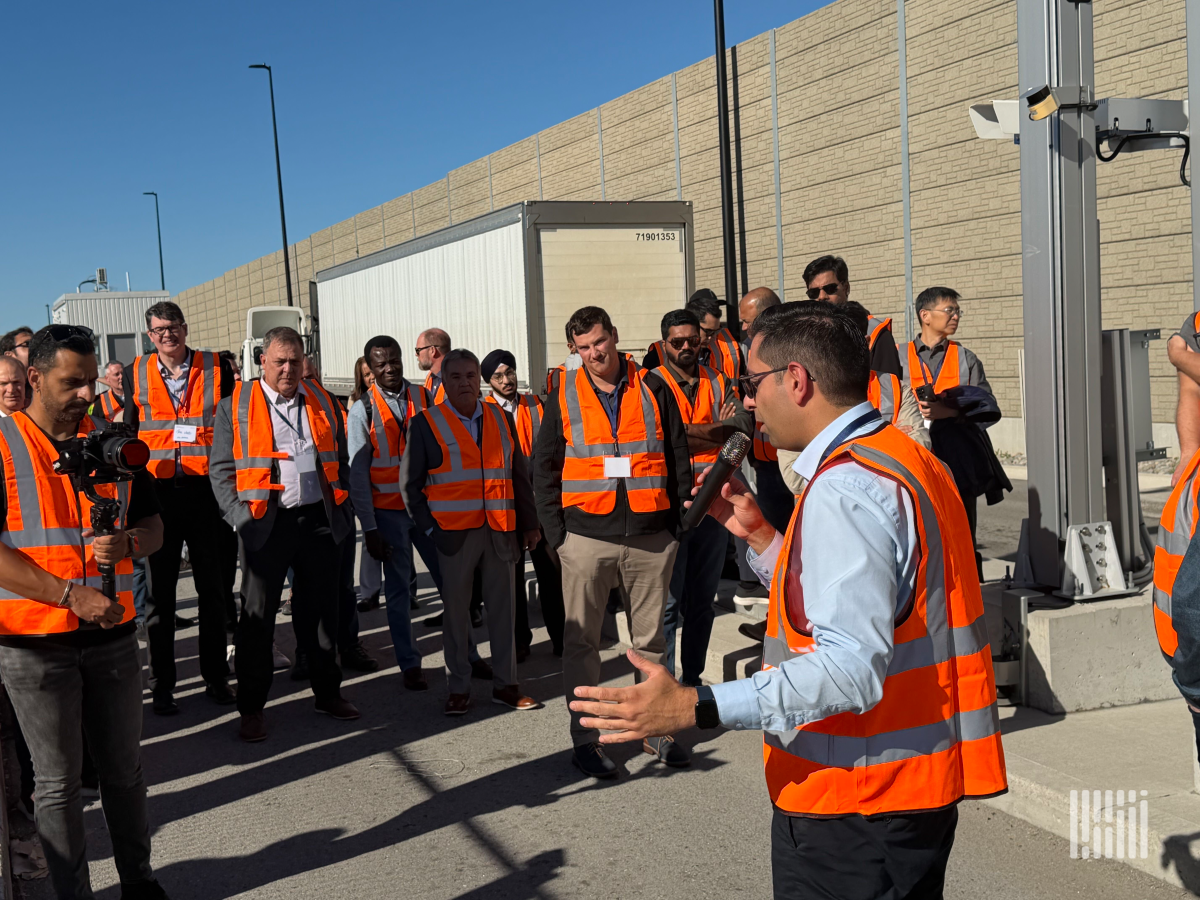
A site walkthrough fills in what a press release cannot.
Seven or Eight API Calls Before the Gate Opens
Every transaction triggers seven or eight API calls across separate systems. Hoss listed them: Manhattan Active, SAP, a supply chain hub layer, Blue Yonder, TruckMate, C3 Solutions for appointments, and Setaris for mechanical records, among others.
Steve Freas, director of transportation systems, walked through the inbound sequence. The supply chain hub validates what is inside the trailer, the transaction moves through to yard management, which verifies the trailer and its contents, and staff inside get a live picture of what is on site. Paperwork goes in, the trailer is checked into the yard management system, its position is recorded, and shunt tasks are kicked off automatically.
The driver population splits along a line that shapes the design. Loblaw’s own fleet drivers, about 30 to 40 percent of traffic, use an in-house application that generates a QR code instantly. The remaining 60 to 65 percent arrive from carriers using the third-party web application. A driver can complete the transaction three ways: on a phone, on the kiosk touchscreen, or on an in-cab tablet from Samsara, Isaac, GeoTab or Platform Science.
Hoss said this site was chosen to demonstrate because it is unusually well integrated, and represents where a lot of customers are trying to get within two years.
Exception Handling Runs Remotely
No automated gate clears every truck, and the design question is what happens to the ones it does not.
Exception handling at this site runs from inside the building rather than from a booth. Fallo described a panel of monitors on her office wall connected to cameras facing the inbound and outbound gates, letting her team watch trucks approach the lane, confirm the booms are operating, and manage flow. A driver who cannot complete a transaction presses a help button on the kiosk to reach the office, and her team can also call the kiosk directly. If the driver still cannot get through, an operator can enter the information on their behalf, which preserves data accuracy rather than leaving a gap in the record.
Hoss noted that other sites configure this differently, running a rework workflow where a failed driver is given roughly 20 seconds to exit the lane before an alert fires. The workflow is configurable by carrier, by load type, by lane and by site.
The categories that generate exceptions are worth understanding at the design stage. Optical character recognition depends on the interaction between what a driver keys in, what the camera reads, and what the yard management system already holds, so a discrepancy in any of the three surfaces at the gate. Trailer chain of custody is its own category: Freas noted Loblaw runs roughly 4,000 trailers nationally and carriers swap them in and out routinely, so a trailer dropped by one carrier and retrieved by another has to be reconciled. On the inbound side, appointment timing drives most of it, with tolerance configurable by carrier.
None of those are camera problems. They are data problems, and an automated gate does not create them so much as surface them at the moment a truck is sitting in the lane waiting. That visibility is useful, and it is also the reason the exception desk needs to be staffed as a real function rather than treated as a rounding error against the labor the automation displaces.
A Pilot Site Carries Its Own Archaeology
The most transferable cost lesson is visible in the hardware, and it is a lesson about what not to build.
Pellegrino was direct that the infrastructure at this site goes well beyond what future locations will need. It was built around a different solution before the company changed direction a year or two in. Hoss described the existing setup as a portal intermodal arc designed four or five years ago for an airport-style gateway, and said an inland operation does not need it. What actually enables the current solution is low-cost posts carrying two cameras on each side. Four cameras replace the entire arc, which is where the estimated 90 to 95 percent reduction in infrastructure cost comes from.
A second gate at this facility exists only as a legacy of the previous technology, which could not associate a tractor passing under the arc with the tractor at the kiosk, so a gate was needed to isolate traffic. It will be removed, and future Loblaw sites are designed as single-gate installations. Hoss noted some customers deliberately keep a second gate as tailgating protection, which is a different reason to have one.
The cameras themselves are ordinary security cameras with nothing proprietary about the hardware. Hoss was explicit that security remains the primary application and the AI analysis runs as a parallel stream, which means an existing camera installation can often be tapped rather than replaced.
Ten sites are currently being assessed. The next goes live in mid-November as a phase one deployment. The stated ambition is automated gates at close to half of Loblaw’s 26 distribution centres over the next couple of years.
Adoption Was Won by Removing the Fallback
The change management account was the least technical and probably the most useful thing said all afternoon.
Fallo described stationing a team member outside near the gate for about two months. Drivers kept pulling up to the window to talk to the person standing there, which meant the kiosk never became the default. The fix was to move the team inside to handle monitoring and exception work, which removed the fallback and made the kiosk the only path. Adoption followed.
The support did not disappear, it changed shape. Her team coached drivers through failures from inside the office, explaining why a transaction had been rejected so the next attempt would succeed. Her assessment is that the driver learning curve was the hardest part of the project, and that the message that mattered was that this is not going away.
Freas added the carrier-side piece. Communication goes out to carrier and vendor partners about a month ahead of go-live so drivers arrive trained. The harder population is one-off drivers representing vendors on prepaid freight, where no ongoing relationship exists to train into.
Software updates run through a change request process with two weeks notice, testing in development and test environments, and deployment in a set window on weekend overnight hours. Updates themselves take minutes, and can be applied lane by lane rather than to an entire site or network at once.
What the Gate Knows
The data capture is narrower than people assume, and the roadmap is wider.
Loblaw does not track vehicle identification numbers. Fallo said most of the fleet drivers are third parties, so the company works from trailer and truck license plates instead. Telematics integration with Samsara pulls reefer temperature, and Freas was specific that it does not pull location data. Temperature is informational today, with validation against required ranges planned, and the same integration reads reefer fuel levels with rules that can prevent a truck leaving below a threshold when there is a fuelling station on site.
Inbound validation currently keys on the appointment. The next phase adds reservation number validation, and the ability for a driver to key a load ID that calls the transportation management system directly is described as coming shortly.
Pellegrino said damage tracking is a priority, driven by the familiar argument over whether a carrier caused damage on the way in or on the way out. Thermal tire monitoring came from a maintenance director who wants overheating tires flagged visually. Both are in development without established timelines.
On autonomous trucks, Freas said routing information combined with the tractor being recorded in the maintenance system would let the gate scan plates and process the move with no driver interaction at all. Hoss described the emerging industry pattern for exceptions as a dedicated waiting area where a person resolves the issue and updates the truck’s routing system before it proceeds.
Why It Matters
The throughput at this site came from reconciling seven or eight enterprise systems in real time, which means any operations leader evaluating gate automation is really evaluating the condition of data they already own rather than the quality of a vendor’s cameras. The infrastructure economics point the same direction, because when the second installation costs a fraction of the first, the decision moves from a capital approval to a network rollout plan.
The post A Look at How Loblaw and EAIGLE Are Bringing Automated Gates to a National Distribution Network appeared first on FreightWaves.