Many LTL shippers notice that freight quotes can vary significantly — even for shipments that appear similar on the surface.
In most cases, the difference is not random. It is typically driven by equipment requirements, delivery conditions, and accessorial services such as liftgate or residential delivery.
While most shippers do not directly choose the truck type themselves, understanding the common equipment used in North American freight can help explain pricing differences and prevent unexpected charges.
Businesses shipping regularly can benefit from working with reliable LTL shipping services that help manage equipment requirements and accessorial risks more effectively.
The Freight Equipment Landscape in North America
For standard palletized general freight, the majority of shipments in Canada and the United States move using a relatively small group of core equipment types.

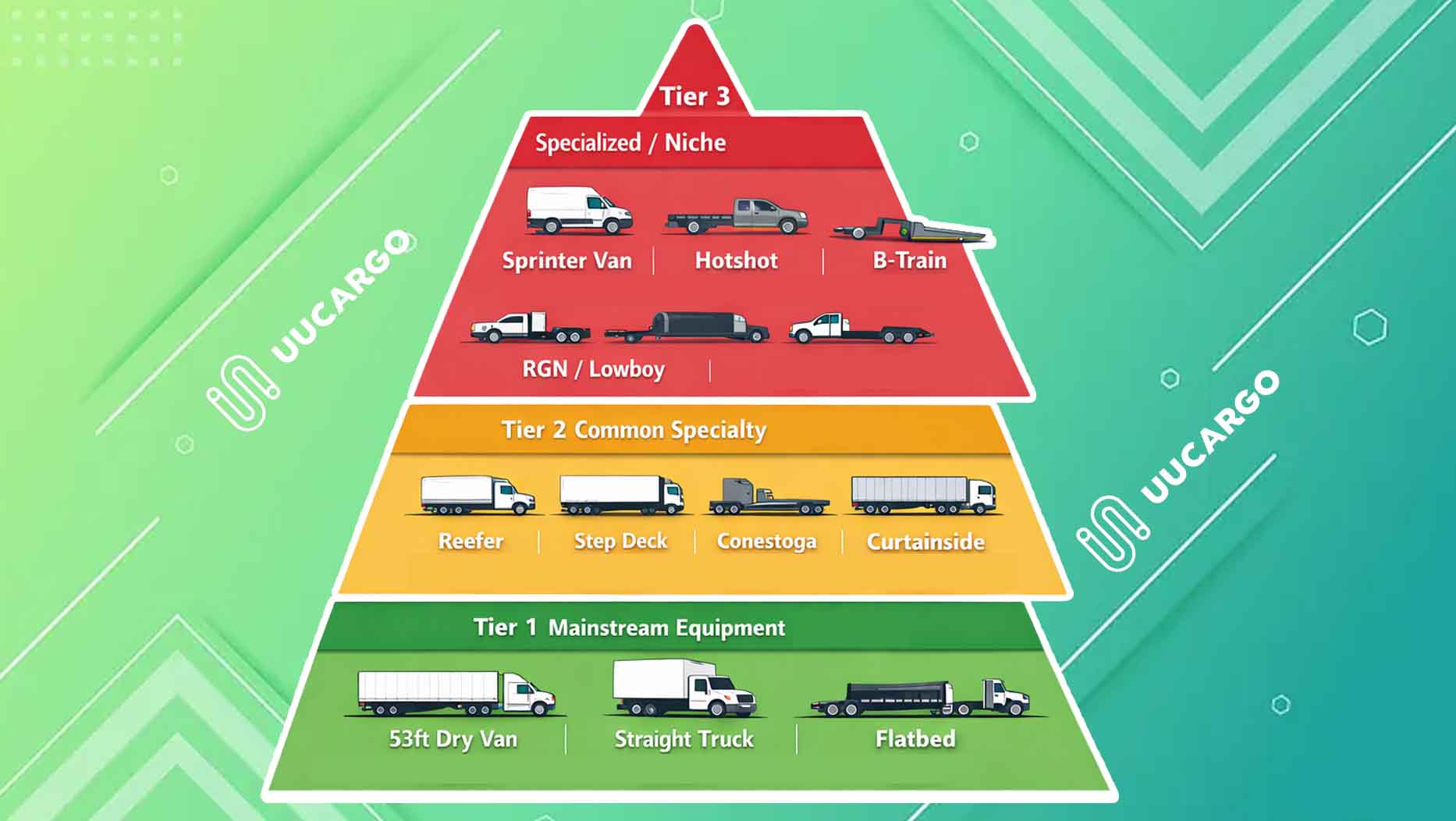
At UU Cargo, we often explain this using a simple freight equipment pyramid:
Tier 1 (Primary equipment) handles most general freight
Tier 2 (Specialty equipment) serves more specific scenarios
Tier 3 (Specialized equipment) is used for niche or project cargo
For most LTL and standard commercial shipments, the discussion typically centers on three primary truck types.
Straight Truck (Box Truck)
Best for: small to mid-size shipments, urban deliveries, and locations without dock access.
Key characteristics
- Typical length: 20–26 ft
- Capacity: approximately 3–8 pallets
- Liftgate often available
- Better maneuverability in city environments
When it is commonly used:Straight trucks are frequently used for local LTL deliveries, retail store replenishment, and commercial locations that do not have dock access.
Because many straight trucks can be equipped with liftgates, they are often the most practical solution when shipping to strip malls, small warehouses, or business units without a loading dock.
53ft Dry Van Trailer
Best for: long-haul freight, warehouse-to-warehouse moves, and high-volume shipments.
Key characteristics
- Standard enclosed trailer
- Capacity: up to 24–26 pallets
- Typically requires dock loading and unloading
- Primary equipment for interprovincial freight
When it is commonly used:The 53ft dry van is the backbone of long-distance freight across Canada and the United States. It is most efficient when both pickup and delivery locations have dock access.This equipment is widely used in domestic distribution as well as cross-border freight solutions between Canada and the United States.
For dock-to-dock shipments or full truckload moves, this equipment usually provides the best linehaul economics.
Common issue
One of the most frequent problems in LTL shipping occurs when a 53ft trailer is scheduled but the delivery location does not have proper dock access. This often leads to additional liftgate fees, equipment changes, or delivery delays.
Flatbed Truck
Best for: oversized, heavy, or non-enclosed freight.
Key characteristics
- No roof or side walls
- Supports overwidth and overheight cargo
- Requires secure strapping
- Common in construction and industrial sectors
When it is commonly used:Flatbeds are typically used for machinery, steel, lumber, and project cargo that cannot be loaded into an enclosed trailer.For most standard palletized freight, however, a flatbed is not required.
What Affects LTL Freight Pricing: Truck Types, Delivery Conditions and Accessorial Fees
Beyond trailer type, delivery conditions are one of the biggest drivers of unexpected LTL costs.
Many first-time shippers focus on weight and distance, but accessorial services frequently determine the final invoice. Below are some of the most common factors that may impact LTL pricing
Residential Delivery
Residential locations typically involve tighter access, longer handling time, and higher delivery complexity.Most carriers apply a residential surcharge when the address is classified as residential.
Liftgate Service
A liftgate is required when freight must be loaded or unloaded at locations without a dock or forklift.
Because it requires special equipment and additional handling time, liftgate service is one of the most common LTL accessorial charges.
Dock & Forklift Availability
Limited Access Locations
When a proper dock and forklift are available at both pickup and delivery, freight can be handled much more efficiently.Dock-to-dock shipments usually experience:
- Lower accessorial costs
- Faster delivery
- Fewer re-delivery risks
Confirming site conditions early is one of the simplest ways to control LTL costs.
Deliveries to locations such as schools, construction sites, military bases, or downtown areas may incur limited access fees due to restricted entry or longer handling time.
Delivery Appointment Requirements
Some receivers require scheduled delivery appointments.
If not arranged in advance, this may result in additional fees or delivery delays.
Re-delivery or Detention Risk
If the receiver is not available, refuses the shipment, or unloading takes excessive time, carriers may apply re-delivery or detention charges.
How UU Cargo Helps Simplify LTL Shipping
UU Cargo works with 50+ carrier partners across Canada and the United States, supporting shipments ranging from small parcel to LTL and full truckload freight.
Because equipment requirements and site conditions vary widely, our team reviews each shipment based on:
- Dimensions
- Weight
- Pallet count
- Dock availability
- Delivery access conditions
This helps shippers avoid unnecessary accessorial charges and select the most cost-effective solution from the start.
For importers managing inbound freight, integrated bonded warehouse support can further streamline customs and distribution workflows.
Conclusion
While most LTL customers do not directly choose the truck type, equipment and delivery conditions play a major role in how freight is priced and executed.
Understanding the basics of common truck types and delivery requirements can help businesses plan more accurately, avoid surprise fees, and keep shipments moving smoothly.
If you would like help reviewing an upcoming shipment, the UU Cargo team is always happy to assist.